
Local Rules
Where Brush Goes, and What It Costs You
Brush is on the free list if you live in the city. The catch is that the free list assumes you are the one doing the hauling.
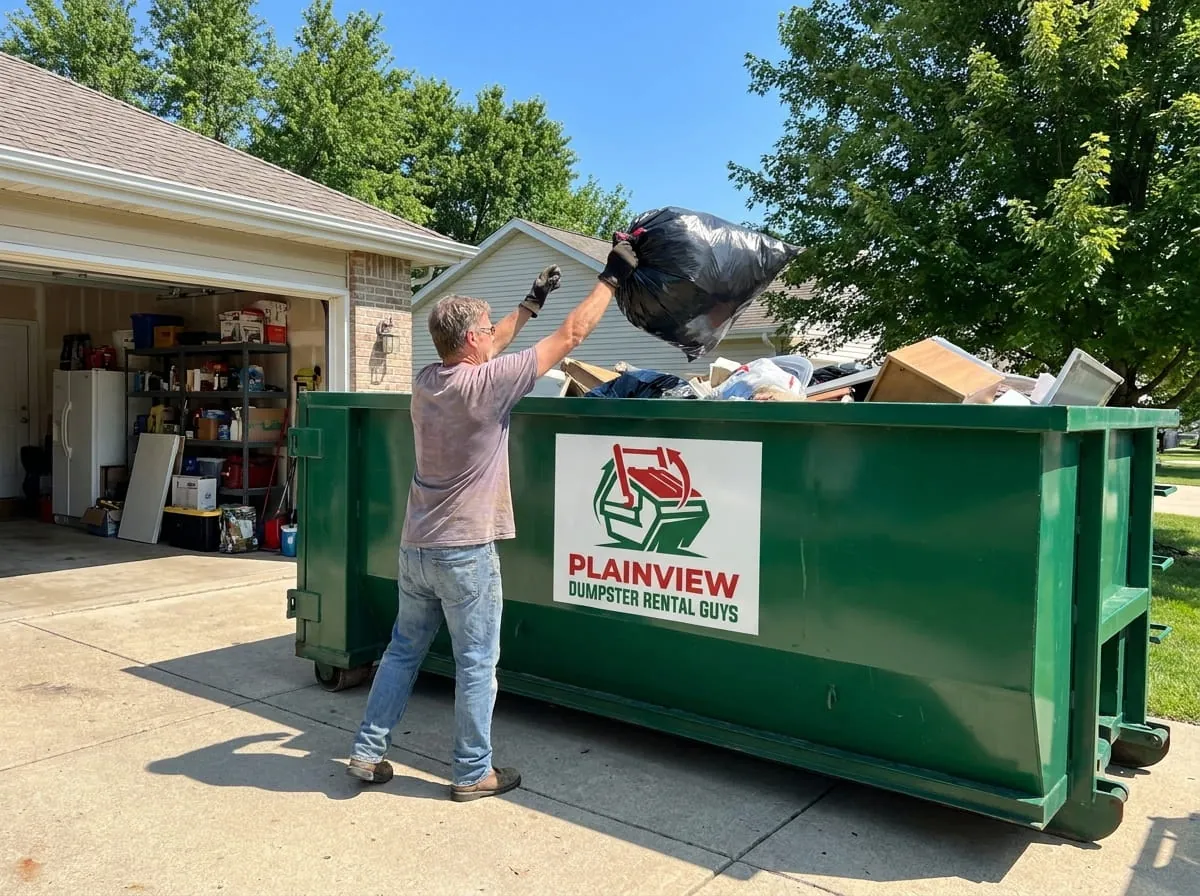
Brush is on the exempt list
Good news first, and it is genuinely good.
City of Plainview residences that pay a City of Plainview water bill are exempt from landfill charges for brush and yard waste, alongside furniture and appliances. Take your ID and the current or previous month's water, sewer and sanitation statement to the gate at 1031 County Road Y, open Monday to Saturday, 8:00 a.m. to 6:00 p.m.
For an ordinary trim-back — a few hours with loppers and a trailer — that is the whole answer, and it costs nothing.
⚠️ But only if you haul it yourself
The exemption is built around a resident with a vehicle. It does not travel.
So the question is not really "is brush free?" It is "who is doing the hauling, and how many loads is it?"
- One trailer load, you own a trailer, you live in the city: free. Go do it.
- Six loads across a weekend you would rather spend otherwise: worth pricing a container.
- Anything a contractor removes: paid, always.
- Anything from outside the city limits: paid, always.
The grinder, and free mulch
What happens to the brush after it arrives is the part worth knowing.
The landfill runs a brush grinder — something like three thousand tons of material through it in a year — and the product goes back out the gate. The landfill gives away mulch and firewood free of charge.
On the High Plains that matters more than it would elsewhere. Topsoil here is thin, caliche sits close to the surface, the wind takes moisture out of bare ground fast, and water is the constraint on everything you plant. Free mulch is the cheapest and most effective soil improvement available in this town.
The landfill also recycles all oil, filters and metal brought to it, and used motor oil and antifreeze can go to the Recycling Center at 1018 E. Fourth Street instead.
What is not brush
The distinction that costs people money on almost every outdoor project.
- Treated timber is not brush. Fence posts, deck boards, landscape ties, anything pressure treated, painted or stained. Essentially all exterior wood out here is treated, so a "wood" pile from a fence demolition is not a brush pile.
- Fence wire is not brush, and there is a lot of it in this country. Worth pulling out as scrap — it has value and it fouls processing equipment.
- Soil and sod are not brush. They are the heaviest material anyone handles and they belong in their own container.
- Caliche and rock are not brush. Same problem, more so.
- Irrigation pipe is not brush. Metal pipe is scrap with real value; PVC is not.
A fence line clearance is therefore four disposal answers at once: brush, treated timber, wire and often old concrete footings. That is exactly the job where one container beats four trips.
⚠️ Outside the city limits
Most of our service area has no exemption of any kind.
Hale Center, Abernathy, Petersburg, Edmonson, Cotton Center and Seth Ward are all in Hale County but outside the Plainview city limits. So are Floydada, Lockney, Tulia, Kress, Olton, Littlefield, Springlake, Dimmitt, Silverton, Ralls and Crosbyton, which are in six other counties besides.
⚠️ Seth Ward is the one that catches people. It sits immediately against the city, close enough that residents assume they are inside it. They are not, and the water-bill exemption stops at the line.
Out there your options are composting on site, a paid load at the gate, whatever your own town provides, or a container.
Mesquite, tree work and root balls
Practical notes for this country specifically.
- Cut it down before loading. A tree loaded whole takes three or four times the space it needs to. This is the single biggest saving available on any brush job.
- Mesquite is dense and awkward, full of thorns, and grows in shapes that waste container space. Cut it shorter than feels necessary.
- Root balls carry soil, and soil is heavy. Knock as much off as you can before it goes in.
- Stumps go in a container, but tell us first — they are dense and they change what we bring.
- Watch for embedded wire in old trees along fence lines. It matters at the processing end.
- Green wood is heavy. Freshly cut timber is full of water and reaches a weight allowance far faster than seasoned wood.
Real tree work out here is mostly confined to older town lots where somebody has watered a cottonwood or an elm for fifty years, and to the breaks near Silverton and Crosbyton where there is genuine native timber.
Sizing a yard job
- Light prunings and a trim-back: use the free route if you can
- A fence line cleared: 20 yard — brush, posts, wire and footings all mixed
- One mature tree down: 20 yard, cut down before loading
- A tree plus stump and root ball: 30 yard, and tell us about the stump
- Landscaping rebuild with soil, sod or rock: 10 yard, part filled — weight binds long before volume
- Deck or arbour demolition: 20 yard — treated timber throughout
- A farmstead shelter belt cleared: 30 yard with swaps
A short checklist
- Brush and yard waste are exempt at the landfill on a City water bill
- Take ID and the current or previous statement — the bill is the proof
- ⚠️ Contractors and lawn services pay, always
- ⚠️ Outside the city limits there is no exemption, Seth Ward included
- Landfill: 1031 County Road Y, Mon–Sat 8 a.m. to 6 p.m.
- Free mulch and firewood go back out the gate — worth collecting
- Treated timber, wire, soil, rock and pipe are not brush
- Cut trees down before loading — it saves three quarters of the space
- Tell us about stumps and root balls before delivery
- Ten tires per person per day is the drop-off limit
Need a container in Plainview?
Call and describe the job. Three minutes on the phone gets you a size recommendation, a flat rate and a delivery window — and we will tell you if a smaller, cheaper container is the right answer.
Call (806) 429-4181